

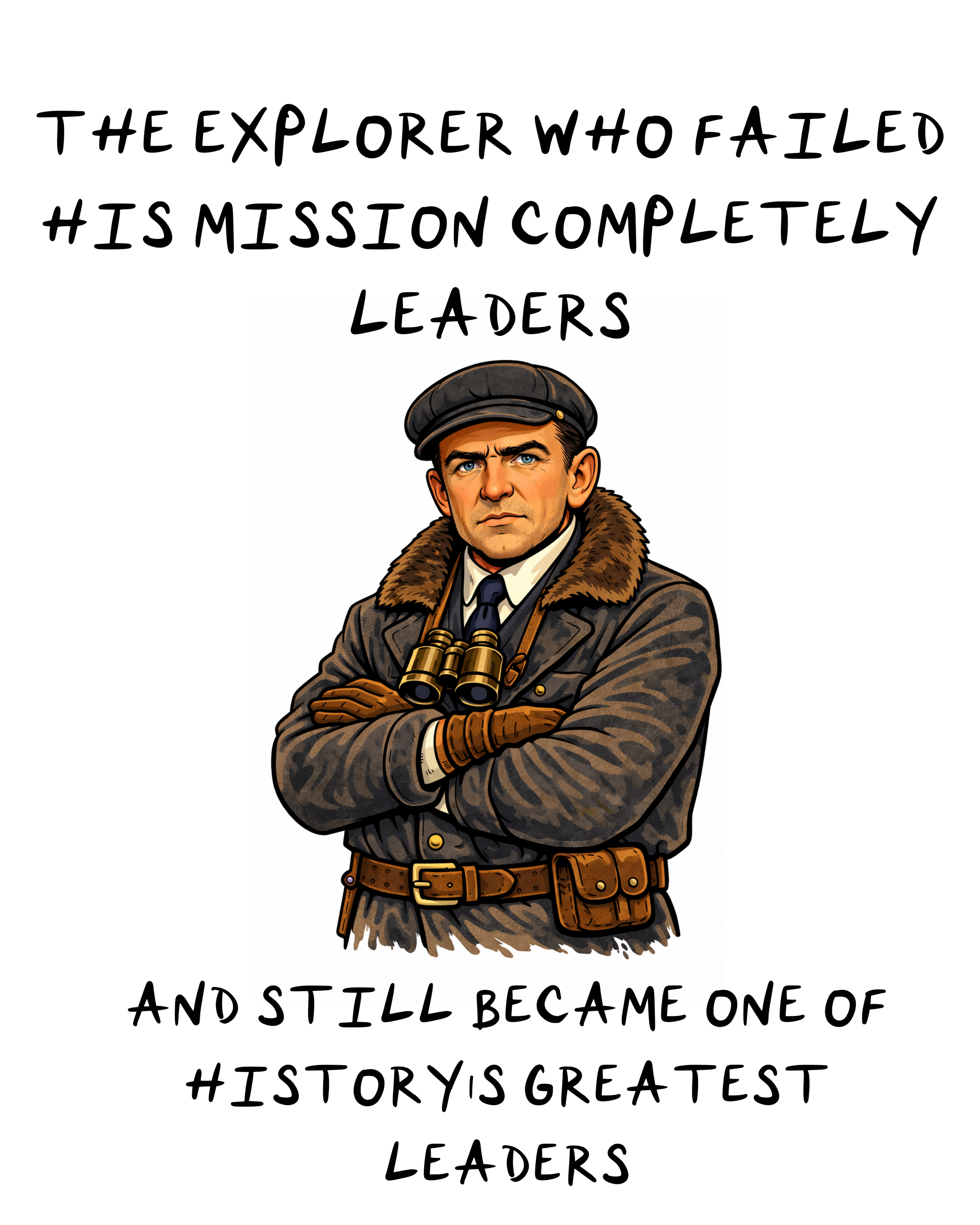
The Explorer Who Failed His Mission Completely—And Still Became One of History's Greatest Leaders
Let’s Connect!
Let's Connect!
Hello Future Entrepreneurs!
Ernest Shackleton failed.
Spectacularly. Publicly. Completely.
His mission? Cross Antarctica on foot—something no human had ever done.
What actually happened? His ship got crushed by ice 1,200 miles from civilization. He never set foot on Antarctica. Never came close to his goal. Spent two years stranded in the most hostile environment on Earth with 27 men, no supplies, and zero hope of rescue.
By every conventional measure, the expedition was a disaster.
And yet, Shackleton is remembered as one of the greatest leaders in history.
Why? Because every single person came home alive.
Not most of them. Not the lucky ones. All of them.
In a situation where death was almost guaranteed, where starvation and frostbite and psychological breakdown should have killed half the crew—everyone survived.
That's not luck. That's leadership at a level most people can't even comprehend.
And the lessons from how he did it? They destroy everything modern business culture tells you about leading through crisis.
-Let's do this.
The Two Ways People Get Crisis Leadership Wrong
When things go sideways, leaders typically fall into two camps.
The "stick to the plan" leaders refuse to admit reality. They keep executing the original strategy even when circumstances have fundamentally changed. "We said we'd do this, so we're doing it."
The "panic and pivot" leaders abandon everything the moment shit gets hard. They thrash between strategies, spread fear, and make reactive decisions that make things worse.
Both approaches kill morale, destroy trust, and often kill the mission entirely.
Shackleton did something completely different.
He acknowledged reality immediately, changed the mission without drama, and kept everyone focused on what actually mattered: survival.
That's not leadership theory. That's crisis management at the highest possible level.
And it's exactly what most modern leaders fail to do when their companies hit trouble.
What Actually Happened (And Why It's More Brutal Than You Think)
Let me give you the real story, because the sanitized version doesn't capture how insane this situation was.
December 1914: Shackleton and 27 men depart on the ship Endurance to cross Antarctica on foot—a 1,800-mile journey across the most hostile continent on Earth.
January 1915: The ship gets trapped in pack ice in the Weddell Sea. They're stuck. Can't move forward, can't retreat.
For 10 months, they're frozen in place while the ice slowly crushes the ship.
October 1915: Endurance finally breaks apart and sinks. They're now stranded on a floating ice sheet with three lifeboats, limited supplies, and no way to call for help. The nearest civilization is over 1,200 miles away.
April 1916: After camping on the ice for months, the ice breaks up. They load into the lifeboats and spend seven days crossing open ocean in subzero temperatures to reach Elephant Island—a barren rock with no food, no shelter, and no chance of rescue.
Here's where most leaders would've given up.
But Shackleton doesn't stop. He takes five men and attempts the impossible: an 800-mile open-boat journey across the most dangerous ocean on Earth to reach a whaling station in South Georgia.
May 1916: After 16 days at sea in a 22-foot boat navigating hurricane-force winds, they land on the wrong side of South Georgia. They then have to cross a mountain range that's never been traversed—no maps, no gear, just desperation.
They make it. Get help. Return to rescue the crew on Elephant Island.
August 1916: After four rescue attempts and 22 months since the ship sank, Shackleton reaches Elephant Island and brings everyone home.
Final count: 28 men departed. 28 men returned. Zero deaths.
That doesn't happen by accident.
The Decision That Saved Everyone (That Most Leaders Would Never Make)
Here's the moment that defines Shackleton's leadership:
When Endurance was trapped and slowly being crushed, Shackleton had a choice.
He could keep pretending the original mission was still possible. Keep morale high by insisting they'd eventually cross Antarctica. Maintain the illusion that everything was fine.
Or he could tell the truth.
He chose truth.
He gathered the crew and said, essentially: "The mission has changed. We're no longer trying to cross Antarctica. We're trying to get everyone home alive. That's the only goal that matters now."
Most leaders can't do this.
They're so attached to the original vision—so terrified of looking like failures—that they keep driving toward a goal that no longer makes sense.
Shackleton had zero ego about it. The mission failed? Fine. New mission: survival.
That shift saved lives.
Because once everyone understood the real goal, decisions became clearer. Resources got allocated differently. Energy got focused on what actually mattered.
Compare that to modern business:
How many companies keep pushing a dying product because admitting failure feels like weakness?
How many CEOs refuse to pivot because they're too invested in the original vision?
How many leaders drive their teams off a cliff because changing course would mean admitting they were wrong?
Shackleton proves that the strongest leaders aren't the ones who never fail—they're the ones who acknowledge failure quickly and adapt without drama.
The Leadership Move Nobody Talks About
Here's what Shackleton did that most leadership books won't tell you:
He managed morale as seriously as he managed logistics.
When you're stranded in Antarctica with no food and no hope of rescue, the biggest threat isn't the cold. It's psychological collapse.
If the crew loses hope, they die. If panic spreads, they die. If morale breaks, they die.
So Shackleton engineered morale the way other leaders engineer operations.
Specific things he did:
1. He kept routines and structure
Even on the ice, they maintained schedules. Daily tasks. Regular meals (however meager). Soccer games on the ice floe.
Why? Because routine creates normalcy. And normalcy keeps people sane when everything else is chaos.
2. He stayed visible and calm
Shackleton never hid in his tent. He was always present, always calm, always steady.
Even when he was terrified (and he was—his journals reveal constant fear), he never showed it to the crew.
Why? Because fear is contagious. If the leader panics, everyone panics.
3. He watched for signs of breaking
Shackleton paid obsessive attention to his men's mental states. Who was withdrawing? Who was getting depressed? Who was losing hope?
When he spotted someone struggling, he'd give them a task. Promote them. Change their role. Anything to keep them engaged and feeling useful.
Why? Because idle minds spiral in crisis. Purpose keeps people alive.
4. He distributed hardship fairly
Shackleton took the hardest shifts. Ate the same rations as everyone else. Endured the same cold, the same exhaustion.
Leaders who hoard privilege during crisis lose trust instantly. Shackleton knew that—so he suffered alongside his crew.
Real example: When they were down to their last supplies, Shackleton made sure the weakest crew members got slightly larger portions. He went hungry so others could maintain strength.
That's leadership. Not speeches. Not vision statements. Sacrifice.
Don't forget to energize your brain and turn that brandOn with 787 Coffee! order online, link below
What Modern Leaders Get Catastrophically Wrong About Crisis
Here's where most CEOs and managers fail when shit hits the fan:
They think leadership is about having answers.
Shackleton didn't have answers. He had no idea if they'd survive. No idea if the rescue attempt would work. No idea if the ice would hold or if they'd starve before help arrived.
But here's what he did have: presence, steadiness, and a refusal to spread his fear to the crew.
That's crisis leadership.
Not knowing what will happen, but staying calm enough that your team can function instead of panic.
Compare this to how most companies handle crisis:
Leaders disappear (stop communicating, hide behind PR)
Decisions get made in secret (team finds out through leaks or rumors)
Blame starts flowing downward (executives protect themselves, employees get scapegoated)
Panic spreads (because nobody knows what's happening)
Shackleton did the exact opposite:
Stayed visible constantly
Communicated clearly and honestly
Took responsibility for everything
Kept the crew informed and engaged
Result: Trust stayed high even when conditions were unbearable.
That's the difference between leaders who survive crises and leaders who collapse under them.

The Uncomfortable Truth About Survival Leadership
Here's what nobody wants to admit:
Shackleton's leadership style only works if you're willing to sacrifice yourself first.
He didn't ask his crew to endure anything he wasn't enduring himself. He took the most dangerous journey (the 800-mile open-boat trip). He went without sleep to keep watch. He ate less so others could eat more.
Most leaders can't do that.
They want the title, the authority, the respect—but they're not willing to carry the weight that comes with it.
Shackleton proves that real leadership is weight, not privilege.
And the moment your team sees you protecting yourself while asking them to sacrifice—trust dies. And in a crisis, lost trust means lost lives (or lost companies).
Modern business equivalent:
When companies do layoffs, who gets cut first?
Usually the lowest-paid employees. Rarely the executives.
When budgets get tight, what gets cut first?
Employee perks and training. Not executive compensation.
Shackleton's model flips that entirely: Leaders absorb the hardship first, then ask the team to endure what's left.
That's how you maintain trust when everything else is falling apart.
Let's get to work. 💯
Want the insider playbook that's helping thousands build wealth without traditional degrees?
Every month, I share the exact strategies, mindset shifts, and real-world tactics that successful entrepreneurs use to create financial freedom—including interviews with millionaires who started with nothing but ambition.
Join 15,000+ game-changers getting the SoyBrandon newsletter. No fluff. No theories. Just proven methods that work.
[Subscribe free here →] Because your breakthrough moment could be in the next email.
The Leadership Lesson That Changes Everything
Here's the most important thing Shackleton figured out:
Success metrics change when survival becomes the goal.
By traditional measures, the expedition failed completely:
Didn't cross Antarctica
Lost the ship
Burned through all resources
Took two years instead of the planned six months
Achieved zero of the original objectives
But by human measures, it was a total success:
28 men departed
28 men returned
Zero deaths
Zero permanent injuries
Crew remained loyal and functional throughout
That reframes everything about how we define winning.
Most founders are so obsessed with the original vision—the growth targets, the market domination, the IPO dream—that they'll destroy their teams trying to achieve it.
Shackleton shows that sometimes the right move is to change the definition of success entirely.
Modern business examples:
Airbnb during COVID: Couldn't stick to growth plans. Shifted to survival mode. Cut 25% of staff but kept everyone else intact. Recovered stronger.
Nintendo after the Wii U failed: Didn't double down on dying hardware. Shifted to mobile + Switch. Saved the company.
Netflix during the DVD-to-streaming transition: Could've clung to the original model. Instead, cannibalized their own business to survive long-term.
The pattern: Leaders who survive are willing to abandon the original plan when circumstances change fundamentally.
The ones who fail are the ones who keep executing a strategy that no longer matches reality.The Uncomfortable Question This Raises
Here's what nobody wants to talk about:
If Chouinard could give away $3 billion to protect the planet, what does that say about billionaires who don't?
Jeff Bezos is worth $180 billion. He could fund climate solutions at 60x the scale of Patagonia's contribution and still be one of the richest people alive.
Elon Musk is worth $250 billion. He talks about saving humanity by going to Mars but won't restructure his companies to maximize environmental impact on Earth.
Mark Zuckerberg is worth $120 billion. He's pledged to give away 99% of his wealth "eventually." Chouinard actually did it.
I'm not saying billionaires are evil. I'm saying Chouinard revealed a choice most of them refuse to make.
You can optimize for wealth, or you can optimize for impact. Very few people can do both.
Chouinard chose impact. And the fact that choice seems radical tells you everything about how broken our system is.
How to Apply Shackleton's Principles to Your Life and Business
Alright, real talk: you're probably not stranded in Antarctica. But you ARE dealing with pressure, uncertainty, and moments where the original plan isn't working.
Here's how to lead like Shackleton whether you're running a company, managing a team, or just trying to survive a hard chapter:
1. Acknowledge When the Mission Has Changed
Shackleton didn't pretend they were still crossing Antarctica. He admitted the mission failed and defined a new one: survival.
Your move: If your original plan isn't working, stop pretending it is. Say it out loud: "The situation has changed. Here's what we're focusing on now."
Ego kills companies. Adaptability saves them.
2. Stay Visible When Things Get Hard
Shackleton never disappeared. He was always present, always calm, always visible.
Your move: When shit hits the fan, double your communication. Daily updates. Be transparent about what's happening and what you're doing about it.
Silence breeds fear. Visibility builds trust.
3. Manage Morale as Seriously as You Manage Operations
Shackleton understood: if the crew loses hope, logistics don't matter—they're dead anyway.
Your move: Check in on your team's mental state. Are they burned out? Losing hope? Feeling disconnected? Address that as urgently as you address revenue problems.
Morale isn't soft. It's survival.
4. Distribute Hardship Fairly
Shackleton took the hardest shifts. Ate the same rations. Suffered alongside his crew.
Your move: When times are tough, leaders should feel it first and most. Don't ask your team to sacrifice while you protect yourself.
Cut your own salary before you cut theirs. Work the hardest hours. Show them you're carrying more weight, not less.
5. Change the Definition of Success When Necessary
Shackleton didn't achieve the original goal. But he saved every life—and that became the real win.
Your move: If the market changed, if the strategy isn't working, if survival is the priority—redefine what success means.
Maybe success isn't hitting revenue targets. Maybe it's keeping the team intact through a downturn. Maybe it's pivoting to a sustainable model instead of chasing growth at all costs.
6. Keep Structure and Routine During Chaos
Even on the ice, Shackleton maintained schedules and routines.
Your move: When everything feels chaotic, create structure. Regular meetings. Clear priorities. Predictable rhythms.
Chaos breeds panic. Routine creates stability.
7. Be the Calmest Person in the Room
Shackleton was terrified—but he never showed it to his crew.
Your move: Process your fear privately. But when you show up for your team, show up steady.
Your emotional state sets the tone. If you panic, they panic. If you're calm, they can function.
What This Means If You're Leading Through Crisis
You don't need all the answers. You don't need a perfect plan. You don't need to pretend everything's fine.
What you need is steadiness, honesty, and a willingness to carry more weight than anyone else.
Shackleton didn't save his crew because he was the smartest or the toughest. He saved them because he:
Admitted when the plan failed
Changed the mission to match reality
Stayed present and calm when everyone else was terrified
Sacrificed himself first before asking others to sacrifice
Managed morale as seriously as logistics
That's crisis leadership.
And it works whether you're stranded in Antarctica or navigating a company through a recession, a pivot, or any moment where the original plan has completely fallen apart.
The Final Truth About Leadership That Nobody Wants to Hear
Here's what Shackleton's story reveals that most leadership advice ignores:
The best leaders don't always achieve the mission. But they always bring their people home.
By conventional business metrics, Shackleton failed. No results. No glory. No historic crossing.
But by human metrics—the only metrics that actually matter—he succeeded completely.
Because at the end of the day, leadership isn't about hitting targets or achieving glory.
It's about getting your people through the storm intact.
Revenue goals matter. Growth targets matter. Vision matters.
But people matter more.
And if you have to choose between protecting your team and protecting your ego—Shackleton shows you exactly what the right choice is.
Most leaders never make that choice. They'll sacrifice their team to save the mission, to avoid admitting failure, to protect their reputation.
Shackleton did the opposite. He sacrificed the mission to save his team.
And 110 years later, we're still talking about it.
That's legacy.