

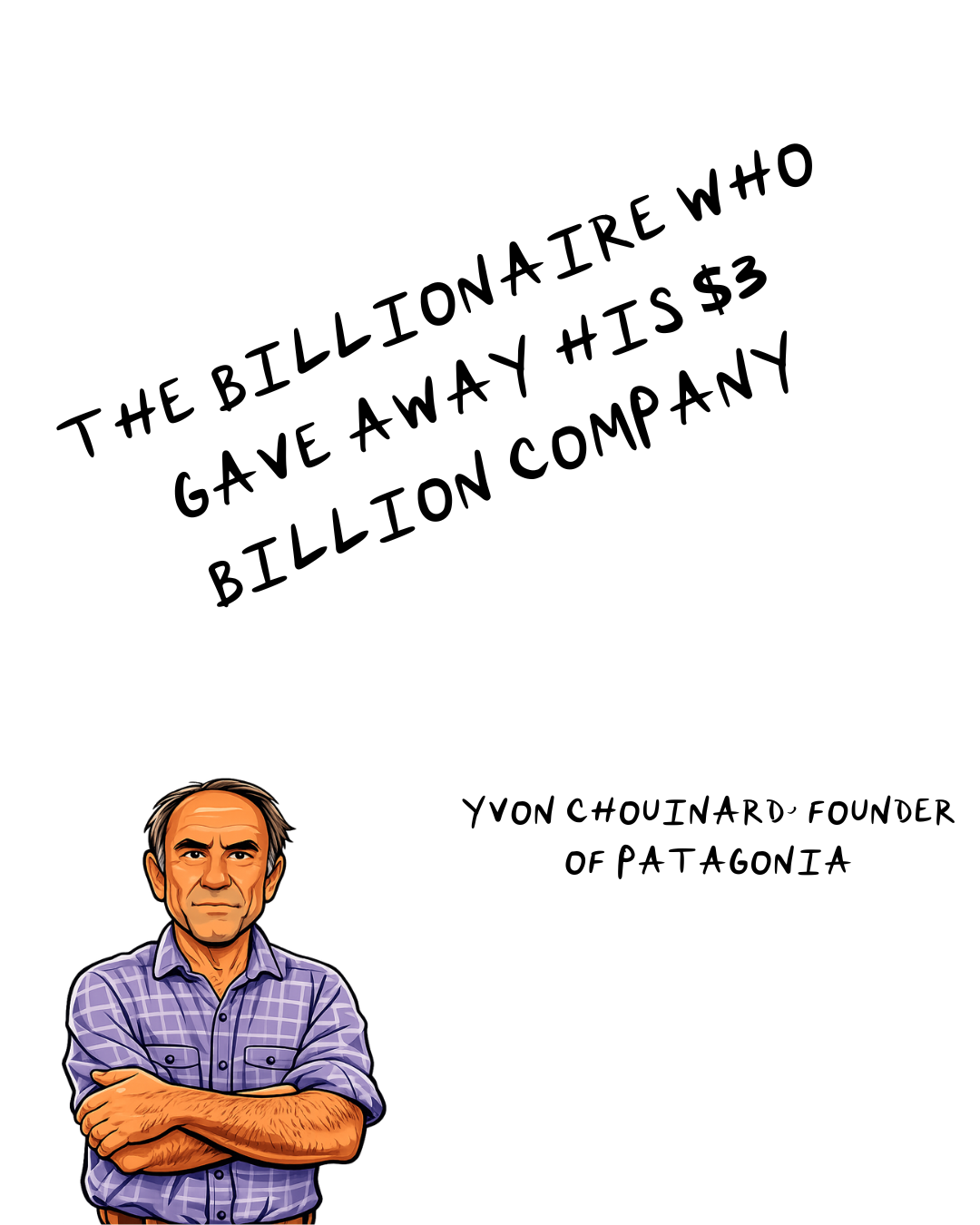
The Billionaire Who Gave Away His $3 Billion Company—And Why That's the Most Radical Thing a Founder Can Do
Let’s Connect!
Let's Connect!
Hello Future Entrepreneurs!
Most founders spend their entire lives trying to get rich.
Build a company. Scale it. Take it public. Cash out. Buy the house, the car, the whatever.
That's the playbook. That's the dream. That's what "winning" looks like in Silicon Valley.
Yvon Chouinard looked at that playbook and said: fuck that.
After building Patagonia into a $3 billion company and one of the most respected brands on the planet, he did something that made every MBA program and venture capitalist completely lose their minds.
He gave it away.
Not sold it for billions. Not took it public. Not handed it to his kids.
He restructured the entire company so that all profits—forever—go toward fighting climate change instead of making him or his family richer.
And in doing so, he proved something most founders are terrified to admit: you don't have to sell your soul to build something that matters.
-Let's do this.
The Two Ways People Get Chouinard Wrong
When Yvon's story hit the news in 2022, the reactions split into two predictable camps.
The inspirational crowd treated him like some enlightened guru who transcended capitalism. "Look at this saint who rejected money!"
The cynics dismissed it as virtue signaling from a guy who's already rich. "Easy to give away money when you've already made yours."
Both groups completely missed what actually happened.
Chouinard didn't reject capitalism. He redesigned it. He didn't give away his company out of guilt or enlightenment—he did it because traditional ownership models were incompatible with what he was trying to build.
That's not sainthood. That's structural innovation disguised as altruism.
And it changes everything about how we should think about building companies.
What Actually Happened (And Why It Matters)
Let me break down what Chouinard actually did, because the headlines don't tell the full story.
The Problem:
Patagonia was worth $3 billion. Yvon was in his 80s. He had two options:
Sell the company - Private equity or a corporate buyer would've paid billions. But they'd optimize for profit, kill the mission, gut the values. Everything Patagonia stood for would be dead within five years.
Go public - Wall Street would demand quarterly growth. Cut costs. Maximize margins. Same result, just slower.
Neither option protected what he'd spent 50 years building.
The Solution:
In 2022, Chouinard restructured Patagonia's ownership:
2% of the company went to a trust controlled by the family (to maintain voting control and protect the mission)
98% of the company went to a nonprofit called the Holdfast Collective
All profits (about $100 million per year) go to fighting climate change
The family gets nothing beyond the trust's administrative role
The Result:
Patagonia can't be sold. Can't go public. Can't be acquired. The mission is legally locked in forever.
Yvon walked away from $3 billion and chose purpose over payout.
But here's the part everyone misses: this wasn't charity. This was strategic design.
Why This Couldn't Have Happened at 99% of Companies
Here's the uncomfortable truth: Chouinard could only do this because he never took venture capital.
Think about that.
If Patagonia had raised VC money, Yvon wouldn't have had the option to give it away. He'd be legally obligated to maximize returns for investors. The board would've forced a sale or IPO. The mission would've died.
But Patagonia was profitable from early on. Grew slowly. Never needed outside money. Which meant Yvon maintained control of his destiny.
The lesson: The fundraising decisions you make in year one determine what options you have in year fifty.
If you take VC money, you're signing up for the exit game whether you realize it or not. You're building to sell, even if you tell yourself you're building to last.
That's not a moral judgment. It's just reality.
Comparison:
Look at what happened to companies that DID take VC money:
Etsy - Started as a mission-driven marketplace for artisans. Went public. Got acquired. Mission diluted.
Whole Foods - Built on organic, local values. Sold to Amazon. Now it's just another grocery chain with better marketing.
Ben & Jerry's - Social mission at the core. Sold to Unilever. Still makes good ice cream, but the activist edge is gone.
The pattern is clear: ownership structure determines mission survival.
Chouinard understood this. So he built a structure where the mission can't be killed.
The Part Where He Could've Been a Billionaire (And Chose Not To)
Let's talk numbers, because this is where it gets real.
If Yvon had sold Patagonia:
Valuation: ~$3 billion
His take (100% owner): ~$3 billion after taxes
He'd be on the Forbes list
His kids would never work a day in their lives
He'd have "won" by every conventional measure
What he actually did:
Gave away 98% to a nonprofit
Family keeps 2% voting control (no financial benefit)
Walked away from $3 billion
Gets nothing except knowing the mission survives
Most people can't comprehend that choice. It violates everything we're taught about success.
But here's what Yvon said: "Instead of extracting value from nature and transforming it into wealth, we are using the wealth Patagonia creates to protect the source."
Read that again.
He's not rejecting wealth. He's redirecting it from personal gain to systemic protection.
That's not anti-capitalism. That's evolved capitalism where profit serves purpose instead of ego.
Don't forget to energize your brain and turn that brandOn with 787 Coffee! order online, link below
This Is the Evolution From Surviving to Thriving
Here's what this mindset shift really means:
It means choosing effectiveness over busyness. Working 50 focused, intentional hours will always beat 80 scattered, reactive ones.
It means building a business that supports your life instead of consuming it. You started this to create freedom, not another prison.
It means leading from fullness instead of emptiness. You can't pour from an empty cup. Take care of yourself so you can actually show up for your team, your customers, your vision.
It means playing the long game. The entrepreneurial journey is a marathon, not a sprint. Optimize for longevity, not just short-term wins.
This is the difference between entrepreneurs who burn bright and burn out versus those who build something lasting.
The Future of Entrepreneurship Isn't About Doing More
It's about being more—mentally sharper, emotionally grounded, purpose-driven, and resilient.
The next generation of successful founders aren't just scaling companies. They're not just optimizing funnels and raising capital and hitting growth targets.
They're mastering themselves first.
They understand that their internal world creates their external results. That you can't build a healthy company from an unhealthy mindset. That sustainable success requires sustainable practices.
Look at the entrepreneurs and leaders who are actually winning long-term. The ones building businesses that last decades, not just exit in a few years. The ones who still have their health, their relationships, their sanity.
They're not the ones glorifying the grind. They're the ones who figured out how to build with intention, lead with coherence, and create from a place of clarity instead of chaos.
That's how you win in 2026 and beyond.
Not by doing more, but by being more deliberate about what you do and why you do it.

What Chouinard Built That Most Founders Ignore
Here's what makes Patagonia different from every other "mission-driven" company:
They don't just talk about values. They build systems that enforce them.
Examples:
1. The "Don't Buy This Jacket" Campaign
In 2011, Patagonia ran a full-page ad on Black Friday that said: "Don't buy this jacket."
They told customers to buy less, repair more, and only purchase what they actually need.
That's insane by traditional business logic. You don't tell customers NOT to buy your product.
But it reinforced the mission. And paradoxically, it made people trust the brand more—which led to more sales long-term.
2. The 1% for the Planet Pledge
Since 1985, Patagonia has donated 1% of sales (not profits—sales) to environmental causes. Over $140 million so far.
That's not marketing. That's a tax they voluntarily impose on themselves because the mission matters more than margins.
3. Repair and Resale Programs
Patagonia actively encourages customers to repair gear instead of buying new. They have a whole division (Worn Wear) dedicated to fixing and reselling used items.
Again: most companies want you to buy new products. Patagonia wants you to keep using old ones.
That only makes sense if your mission is environmental protection, not profit maximization.
Let's get to work. 💯
Want the insider playbook that's helping thousands build wealth without traditional degrees?
Every month, I share the exact strategies, mindset shifts, and real-world tactics that successful entrepreneurs use to create financial freedom—including interviews with millionaires who started with nothing but ambition.
Join 15,000+ game-changers getting the SoyBrandon newsletter. No fluff. No theories. Just proven methods that work.
[Subscribe free here →] Because your breakthrough moment could be in the next email.
The Leadership Model That Changes Everything
Here's what Chouinard proved that most founders miss:
You can lead without needing to own everything.
Most founders equate leadership with control. If they're not majority shareholders, they feel powerless. If they step back, they feel irrelevant.
Chouinard showed a different path: stewardship over ownership.
He didn't see himself as Patagonia's owner. He saw himself as its temporary guardian—responsible for protecting it and handing it off to the next generation in better shape than he found it.
That mindset changes everything:
You think in decades, not quarters
You build systems that outlast you
You prioritize mission over personal gain
You design for succession, not extraction
Real talk: Most founders can't do this. Their ego is too wrapped up in being "the guy who built it." Letting go feels like death.
But Chouinard's model shows that the opposite is true: letting go is how you ensure it lives forever.
The Uncomfortable Question This Raises
Here's what nobody wants to talk about:
If Chouinard could give away $3 billion to protect the planet, what does that say about billionaires who don't?
Jeff Bezos is worth $180 billion. He could fund climate solutions at 60x the scale of Patagonia's contribution and still be one of the richest people alive.
Elon Musk is worth $250 billion. He talks about saving humanity by going to Mars but won't restructure his companies to maximize environmental impact on Earth.
Mark Zuckerberg is worth $120 billion. He's pledged to give away 99% of his wealth "eventually." Chouinard actually did it.
I'm not saying billionaires are evil. I'm saying Chouinard revealed a choice most of them refuse to make.
You can optimize for wealth, or you can optimize for impact. Very few people can do both.
Chouinard chose impact. And the fact that choice seems radical tells you everything about how broken our system is.
How to Apply This to Your Life and Business
Alright, real talk: most of us aren't building billion-dollar companies. So what does Chouinard's story actually mean for you?
Here's how to apply his principles whether you're running a startup, leading a team, or just trying to live with more intention:
1. Define What You're Actually Building Toward
Chouinard didn't wake up one day and decide to give his company away. He spent 50 years being clear about what mattered: protecting the planet, making quality products, treating people well.
Your move: Write down what success actually means to you. Not what Instagram says. Not what your parents want. What do YOU care about?
If you don't define it, someone else will define it for you—and you'll wake up at 50 having built someone else's dream.
2. Design Systems That Enforce Your Values
Chouinard didn't rely on willpower or good intentions. He built legal structures, policies, and business models that made it impossible to betray the mission.
Your move: Look at how you spend time and money. Do your systems reflect your stated values, or contradict them?
If you say family matters, but work 80-hour weeks, your system is broken
If you say health matters, but have no boundaries around work, your system is broken
If you say purpose matters, but only optimize for money, your system is broken
Fix the system, not just the behavior.
3. Think in Decades, Not Quarters
Chouinard could walk away from $3 billion because he was playing a 50-year game, not a 5-year game.
Your move: What would you do differently if you knew you'd be doing this for 30 more years? Would you still take that shortcut? Would you still burn those relationships? Would you still sacrifice your health?
Long-term thinking changes everything.
4. Build to Hand Off, Not Hold On
Chouinard designed Patagonia to thrive without him. Most founders design companies that collapse the moment they leave.
Your move: Whether it's a business, a team, or a project—are you building something that can outlast you? Or are you creating dependency on your presence?
Great leaders make themselves unnecessary over time.
5. Measure Success by What Survives You
Chouinard won't be remembered for being rich. He'll be remembered for protecting what he built and ensuring it continues protecting the planet long after he's gone.
Your move: How do you want to be remembered? What do you want to leave behind that's better than you found it?
That's not morbid. That's clarity.
What This Means If You're Building Something
You don't have to give away your company to lead with purpose.
But you do have to decide: are you building to extract, or to protect?
Are you optimizing for personal wealth, or lasting impact?
Are you creating something that dies when you leave, or something that thrives without you?
Yvon Chouinard didn't reject success. He redefined it.
Success isn't how much you accumulate. It's what you enable to continue after you're gone.
That's not soft. That's the hardest, most mature form of leadership there is.
Most founders never get there. They're too busy protecting their equity, their title, their ego.
Chouinard let go of all of it. And in doing so, he built something that will outlast every tech unicorn that sold for billions and disappeared within a decade.
The Final Lesson Nobody Wants to Hear
Here's the uncomfortable truth about Chouinard's story:
Most people won't do this. Not because they can't, but because they won't.
Because giving away $3 billion requires you to believe something is more important than your personal wealth. And most people, when faced with that choice, choose the money.
That's not a moral failing. It's human nature.
But it does mean that the Yvon Chouinards of the world are rare. And that's exactly why his story matters.
He showed that another path exists. That you can build something massive and still protect what matters. That profit and purpose don't have to be enemies.
You just have to be willing to design for it from the beginning—and hold that line even when everyone tells you you're crazy.
The question isn't whether you have a billion-dollar company to give away.
The question is: are you building something worth protecting?
And if so, what are you willing to sacrifice to protect it?
Ready to build a business that lasts? Subscribe to the soybrandon.com newsletter for monthly strategies on leadership, growth, and building something that matters.