

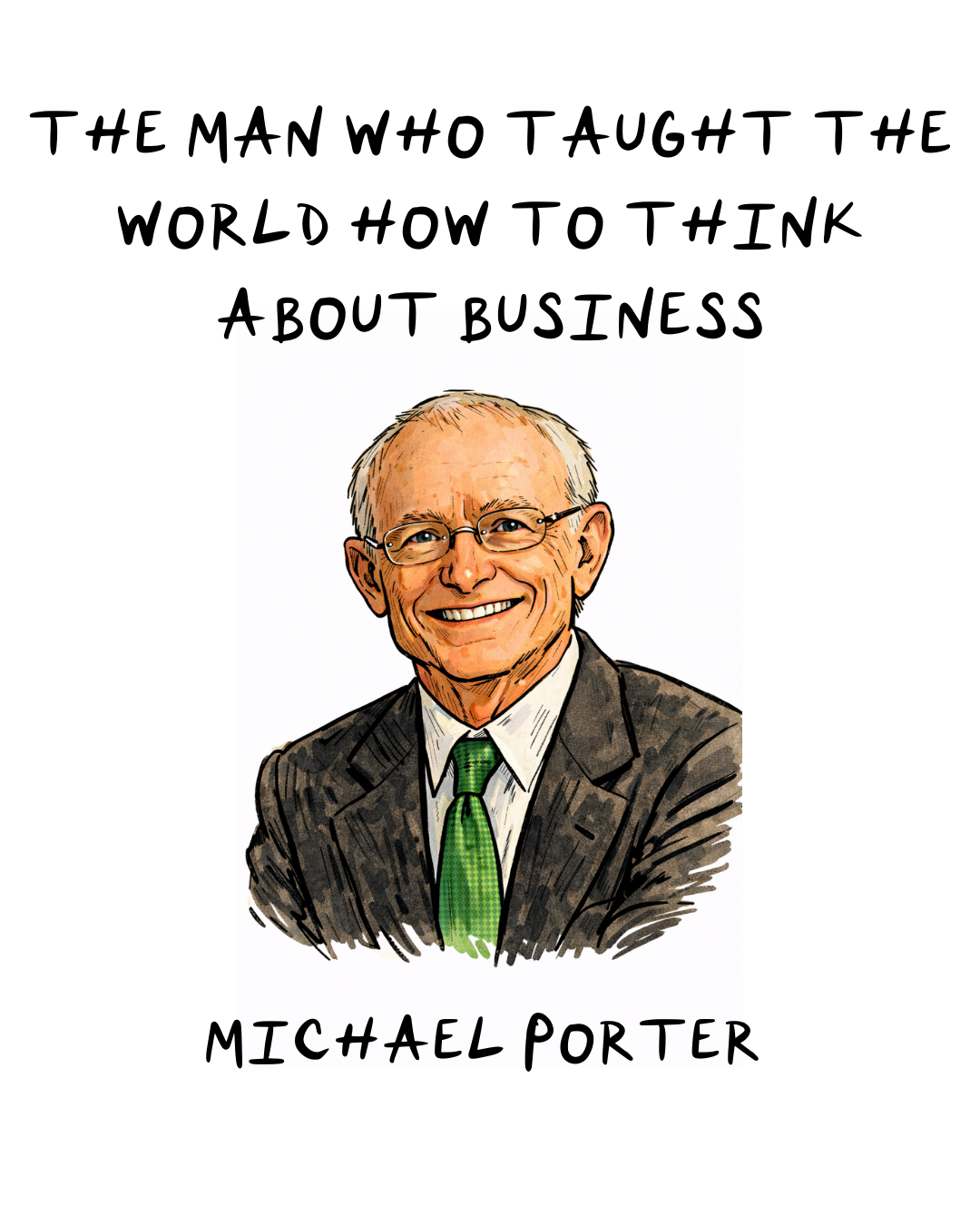
The Man Who Taught the World How to Think About Business—And Why Most Entrepreneurs Still Don't Get It
Let’s Connect!
Let's Connect!
Hello Future Entrepreneurs!
Most businesses don't fail because of bad ideas.
They don't fail because founders aren't working hard enough. They don't fail because of bad luck or timing or the economy.
They fail because nobody actually understands what the hell they're competing against.
You think your problem is pricing. Or that competitor who just copied your product. Or that you're not hustling hard enough.
But here's what's actually killing you: you're exhausted because you're solving the wrong problems. You're stressed because you're reacting to forces you can't see. You're confused because nobody ever taught you how to think clearly about what's really happening.
One man changed that.
His name is Michael Porter. And if you've ever heard phrases like "competitive advantage," "industry forces," or "value chain," you've felt his influence—even if you've never heard his name.
Porter didn't build a startup. Didn't sell a course. Didn't chase trends on LinkedIn.
He did something harder: he gave leaders the language to understand what's actually happening around them.
And that changed everything.
-Let's do this.
The Two Ways People Get Porter Wrong
When Porter's name comes up in business circles, people split into two camps.
The academics treat him like some untouchable genius whose frameworks are sacred texts that can't be questioned.
The hustlers dismiss him as ivory tower theory that doesn't work in the real world. "Cool model, bro. Doesn't help me close deals."
Both groups are completely missing the point.
Porter's work isn't about memorizing diagrams or impressing people at conferences. It's about clarity. About understanding that not every business problem is your fault—and that some forces are bigger than your effort level.
That's the part nobody talks about. And it's exactly why most entrepreneurs are drowning.
Why Your Stress Isn't Always Personal
Here's what nobody tells you when you start building something:
Not every struggle means you messed up.
Sometimes your margins shrink not because you're bad at business—but because three competitors just copied your model and started a price war.
Sometimes growth slows not because you lost your edge—but because customers suddenly have five new options they didn't have last year.
Sometimes you're exhausted not because you're weak—but because you're fighting forces you don't fully see.
Porter's Five Forces framework broke this down in a way that actually makes sense:
Five things are always pushing against your business:
Competitors in your space
New entrants trying to take your customers
Suppliers who control what you pay
Customers who control what you can charge
Substitute products that solve the same problem differently
Once you see this, stress stops feeling like a personal failure.
It starts feeling like a strategic signal.
You're not broken. You're just operating in a system with pressure coming from multiple directions. And once you understand where that pressure is coming from, you can actually do something about it.
The Problem With "Just Execute Harder"
In today's culture, speed is worshipped. Pausing is seen as weakness.
Move fast. Break things. Hustle harder. Never stop grinding.
But Porter's work quietly argued the opposite.
He believed that leaders who don't think deeply end up reacting endlessly.
They chase competitors. Copy trends. Burn out trying to stay relevant instead of intentional.
If this sounds familiar, keep reading.
I've seen this firsthand—founders who assume every setback means they need to work more hours. Add more people. Launch more products. Make more noise.
But more effort without clarity just means you're running faster in the wrong direction.
Porter gave leaders permission to ask better questions instead of rushing toward louder answers.
Here's what most people think leadership looks like:
Always having the answer
Moving faster than everyone else
Never showing weakness
Reacting immediately to every threat
Here's what it actually is:
Knowing when to pause and think
Understanding what you're up against before you move
Admitting when external forces (not personal failure) are the problem
Choosing intentional action over reactive chaos
Thinking isn't procrastination. It's the only thing that keeps you from burning out chasing problems that don't actually matter.
You want to receive more brandOn VALUE, subscribe to YouTube Channel! click link below
Strategy Isn't About Beating Everyone—It's About Knowing What Game You're Playing
One of Porter's biggest contributions was this idea:
You don't need to beat everyone. You need to understand where you belong.
Not every business should compete on price.
Not every brand should scale aggressively.
Not every founder should chase the same definition of success.
Strategy, at its core, is choosing—and being okay with what you don't choose.
That makes people uncomfortable. It's also the only thing that actually works.
Porter identified three generic strategies:
Cost Leadership - Be the cheapest (Walmart, Southwest Airlines)
Differentiation - Be meaningfully different (Apple, Tesla)
Focus - Own a specific niche (Ferrari, In-N-Out Burger)
The mistake most entrepreneurs make? Trying to do all three at once.
They want to be the cheapest AND the most premium AND serve everyone. That's not strategy. That's confusion with a pitch deck.
When you stop trying to win every game, you start building a business that actually fits who you are.
Real example: Southwest Airlines didn't try to compete with Delta on luxury or international routes. They focused on short-haul, point-to-point flights with low costs and fast turnarounds. They chose one game and dominated it.
Meanwhile, dozens of airlines tried to be everything to everyone. Most of them are dead now.
Don't forget to energize your brain and turn that brandOn with 787 Coffee! order online, link below
What Actually Happened When Companies Ignored This
Let's get concrete.
Blockbuster vs. Netflix:
Blockbuster thought they were in the movie rental business competing on convenience and selection. They were actually in the entertainment access business—and Netflix understood the underlying forces (technology, customer behavior, distribution costs) way better.
Blockbuster kept optimizing stores. Netflix changed the game entirely.
Kodak vs. Digital Photography:
Kodak invented digital photography. Then ignored it because it threatened their film business. They thought their competitive advantage was making better film.
It wasn't. Their advantage was helping people capture memories. Once they lost sight of that, they lost everything.
The Pattern:
Companies that focus only on their direct competitors miss the bigger forces reshaping their industry. They're playing checkers while the board is turning into chess.
Porter's work helps you see the board.The Future of Entrepreneurship Isn't About Doing More
It's about being more—mentally sharper, emotionally grounded, purpose-driven, and resilient.
The next generation of successful founders aren't just scaling companies. They're not just optimizing funnels and raising capital and hitting growth targets.
They're mastering themselves first.
They understand that their internal world creates their external results. That you can't build a healthy company from an unhealthy mindset. That sustainable success requires sustainable practices.
Look at the entrepreneurs and leaders who are actually winning long-term. The ones building businesses that last decades, not just exit in a few years. The ones who still have their health, their relationships, their sanity.
They're not the ones glorifying the grind. They're the ones who figured out how to build with intention, lead with coherence, and create from a place of clarity instead of chaos.
That's how you win in 2026 and beyond.
Not by doing more, but by being more deliberate about what you do and why you do it.

The Uncomfortable Truth About Competitive Advantage
Here's where it gets real.
Most founders think competitive advantage means being "better" at something. Better product. Better service. Better marketing.
But Porter said something different: competitive advantage means doing something your competitors literally can't copy—or won't want to.
That could be:
Economies of scale they can't match (Amazon)
A brand they can't replicate (Nike)
Network effects they can't overcome (Facebook)
Proprietary technology they don't have (Google Search)
A cost structure they can't achieve (Costco)
If your competitive advantage is just "we work harder" or "we care more," you don't have a competitive advantage. You have a temporary lead that disappears the moment someone else decides to care.
That's not cynical. That's honest.
And honesty is what keeps you from wasting years building something that can't last.
Let's get to work. 💯
Want the insider playbook that's helping thousands build wealth without traditional degrees?
Every month, I share the exact strategies, mindset shifts, and real-world tactics that successful entrepreneurs use to create financial freedom—including interviews with millionaires who started with nothing but ambition.
Join 15,000+ game-changers getting the SoyBrandon newsletter. No fluff. No theories. Just proven methods that work.
[Subscribe free here →] Because your breakthrough moment could be in the next email.
What This Means If You're Building Something
If you're in your first year of business—or your tenth—here's what matters:
You don't need to hustle harder.
You don't need to copy what's trending. You don't need permission to think differently.
You need clarity.
Clarity about your space.
Clarity about your strengths.
Clarity about what pressures are real—and which ones you're carrying unnecessarily.
Practical steps:
Map your Five Forces. Seriously. Take an hour and write down who's pressuring you from each direction. You'll be shocked how much becomes obvious.
Choose your strategy. Cost, differentiation, or focus. Pick one. You can't be all three.
Identify what you won't do. Strategy is as much about saying no as saying yes. What games are you NOT playing?
Look for structural advantages. What can you build that's hard to copy? Scale? Brand? Network? Proprietary tech?
Stop comparing yourself to everyone. If you're playing a different game, different rules apply.
Michael Porter taught the world how to think about business.
Your job is to decide how you'll use that clarity—not just to build something profitable, but something sustainable.
Because the strongest leaders aren't the loudest.
They're the ones who understand what's really going on—and move with intention instead of panic.
The Lesson Everyone Misses
Porter didn't motivate people with hype.
He grounded them with understanding.
In a world that constantly tells entrepreneurs to do more, scale faster, and never slow down—his work reminds us that longevity comes from awareness, not chaos.
Businesses don't collapse overnight. They drift. They lose focus. They stop thinking clearly about what they're actually competing against.
Porter gave us tools to notice the drift before it becomes damage.
Most people won't use them. They'll keep reacting, keep hustling, keep burning out wondering why effort alone isn't enough.
But if you're reading this, you're not most people.
You're someone who's willing to slow down long enough to see what's actually happening. To think strategically instead of just working harder.
That's not weakness. That's how you build something that lasts.
Don't forget to energize your brain and turn that brandOn with 787 Coffee ☕️
Subscribe!
Sign up with your email address to Turn YOUR brandON.