

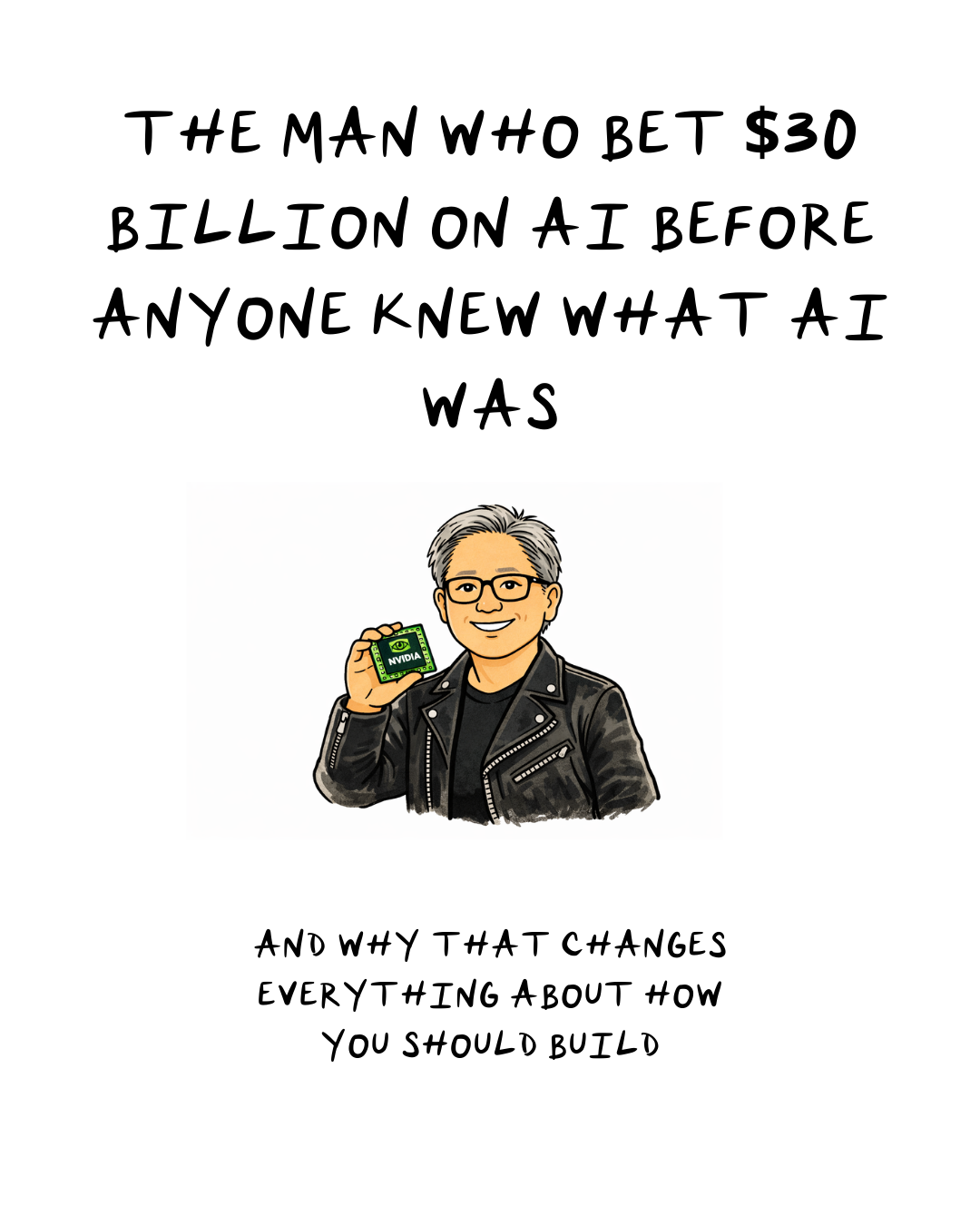
The Man Who Bet $30 Billion on AI Before Anyone Knew What AI Was—And Why That Changes Everything About How You Should Build
Let’s Connect!
Let's Connect!
Hello Future Entrepreneurs!
Everyone's losing their minds over AI right now.
ChatGPT. Midjourney. Every startup with "AI-powered" in their pitch deck. VCs throwing money at anything that mentions machine learning.
The hype is deafening.
But almost nobody is talking about the man who made all of this possible—not with hype, not with viral tweets, but by making one massive bet that took 30 years to pay off.
That man is Jensen Huang, CEO of NVIDIA.
And his story completely destroys everything Silicon Valley tells you about how to build a successful company.
No pivoting every six months. No "fail fast" bullshit. No chasing whatever's trending on Product Hunt.
Just one audacious bet, held for three decades, while everyone else thought he was wasting his time.
-Let's do this.
The Two Ways People Get Jensen Huang Wrong
When Jensen's name comes up, people split into two camps.
The "overnight success" crowd acts like NVIDIA just appeared out of nowhere in 2023 when AI exploded. Like Jensen got lucky timing the market.
The tech purists dismiss him as "just a hardware guy" who happened to be in the right place when software finally needed better chips.
Both groups are completely missing what actually happened.
Jensen didn't get lucky. He didn't stumble into AI dominance. He spent 30 years building the infrastructure for a future that didn't exist yet—while his competitors laughed at him for wasting resources on "niche" technology.
That's not luck. That's conviction that looks insane until it doesn't.
The "Overnight Success" That Took Three Decades
Let me give you the actual timeline nobody talks about.
1993: Jensen co-founds NVIDIA. The company focuses on graphics processing units (GPUs) for gaming and 3D rendering.
1999: NVIDIA goes public. Stock price: $12. Everyone thinks they're just a gaming company.
2006: Jensen makes the bet that changes everything. He launches CUDA—a platform that lets GPUs do general-purpose computing, not just graphics.
The market doesn't care. Wall Street doesn't get it. Even NVIDIA's own engineers think it's a distraction from their core business.
Jensen keeps building anyway.
2012: AI researchers discover that NVIDIA's GPUs are perfect for training neural networks. Not because Jensen designed them for AI—but because the parallel processing architecture happens to be exactly what deep learning needs.
This is where it gets interesting.
Most CEOs would've pivoted immediately. Rebranded as an "AI company." Chased the new shiny thing.
Jensen didn't pivot. Because he'd been preparing for this moment for six years. CUDA wasn't an accident—it was infrastructure built for a future he could see but couldn't yet prove.
2016: AI goes mainstream. Google, Facebook, Amazon, everyone starts buying NVIDIA chips by the thousands.
2023: NVIDIA's market cap hits $1 trillion. Stock price: over $400. A $10,000 investment in 1999 is now worth over $3 million.
Jensen Huang is suddenly a "visionary."
But here's what actually happened: he made one big bet in 2006 and refused to abandon it when everyone said he was wrong.
That's not vision. That's conviction with a 17-year patience timeline.
What Silicon Valley Gets Catastrophically Wrong About Innovation
Silicon Valley worship speed.
Move fast. Break things. Pivot constantly. If something doesn't work in six months, kill it and try something else.
Jensen Huang's entire career is proof that this advice is garbage for anything that actually matters.
Here's what the "fail fast" crowd believes:
Test everything quickly
Pivot when growth slows
Chase whatever's hot right now
Kill projects that don't show immediate ROI
Adapt to the market constantly
Here's what Jensen actually did:
Bet everything on one thesis
Ignored the market for 15+ years
Kept investing in technology with no clear customer
Refused to pivot when Wall Street got impatient
Built infrastructure before anyone knew they needed it
One approach gets you short-term wins and medium-term irrelevance.
The other approach gets you a trillion-dollar company that owns an entire category.
The difference? Time horizon.
Most founders optimize for the next funding round. Jensen optimized for the next decade.
Most CEOs ask "What does the market want right now?" Jensen asked "What will the market need in 2025 that doesn't exist in 2006?"
That's not reckless. That's strategic patience that looks like stubbornness until it pays off.
The Leadership Style Nobody Talks About
Here's what makes Jensen different from every other tech CEO you've heard of.
He's not charismatic like Steve Jobs. He's not a walking meme like Elon Musk. He's not a media darling like Mark Zuckerberg.
He's known for two things inside NVIDIA:
1. He Actually Understands the Technology
Jensen isn't a "business guy" who delegates all technical decisions. He's an engineer who stayed close to the work. He asks hard questions in product reviews. He understands the architecture.
When your CEO understands what you're building, you can't hide behind jargon or excuses. That creates a culture of excellence because bullshit doesn't fly.
2. He Operates With Zero Hierarchy
NVIDIA doesn't have traditional layers of management. Jensen has something like 50+ direct reports. Anyone can email him. He reads technical papers. He shows up in engineering discussions.
That's insane by conventional management wisdom. But it works because it keeps the company fast and removes the bureaucracy that kills innovation.
Most CEOs create distance. Jensen creates proximity.
And proximity to the work is how you spot opportunities 15 years before your competitors.
Don't forget to energize your brain and turn that brandOn with 787 Coffee! order online, link below
The problem: Nobody asked for this. There was no market. No clear ROI. Just a hunch that parallel processing would eventually matter for something beyond rendering video game graphics.
The cost: Hundreds of millions in R&D. Years of effort. Resources diverted from the core gaming business.
The skepticism: Even inside NVIDIA, people thought it was a waste. Wall Street definitely thought it was a waste.
But Jensen held the line.
He didn't just fund CUDA—he evangelized it. Went

Let's get to work. 💯
Want the insider playbook that's helping thousands build wealth without traditional degrees?
Every month, I share the exact strategies, mindset shifts, and real-world tactics that successful entrepreneurs use to create financial freedom—including interviews with millionaires who started with nothing but ambition.
Join 15,000+ game-changers getting the SoyBrandon newsletter. No fluff. No theories. Just proven methods that work.
[Subscribe free here →] Because your breakthrough moment could be in the next email.