

When a Leader Steps Away, the Work Should Speak for Them
Let’s Connect!
Hello Future Entrepreneurs!
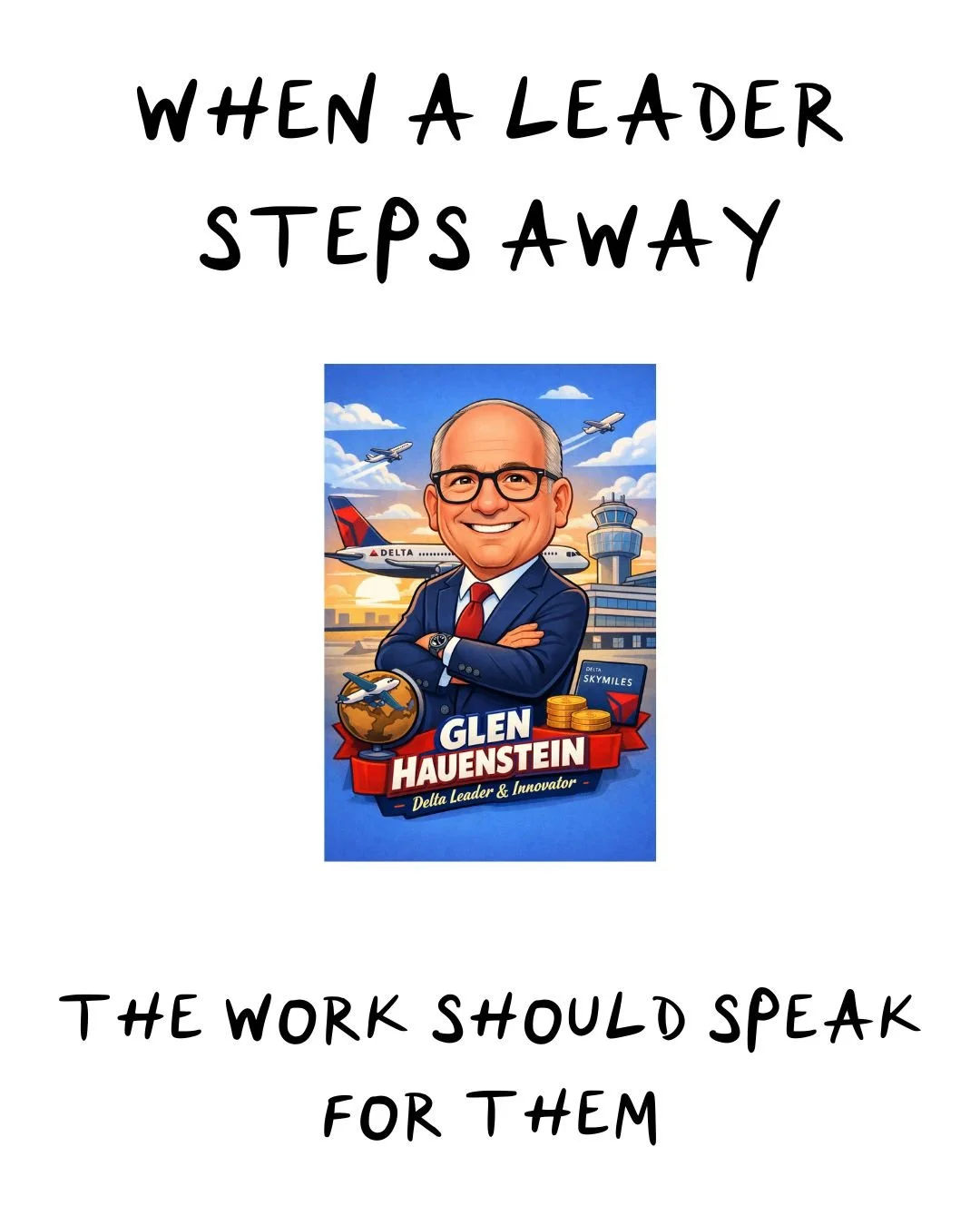
Delta's President Glen Hauenstein is retiring after two decades of shaping the airline into what it is today.
No drama. No emergency replacement. No panicked search for someone to "save" the company. Just a smooth transition to leaders who were already being developed internally.
That's the whole story—and also the entire point.
Most leadership transitions reveal the truth about what was actually built. And what Delta's revealing right now is worth paying attention to.
-Let’s dive in.
The Real Test of Leadership
Most people think leadership shows up in the wins. The big deals. The revenue numbers. The press releases where everyone says the right things.
But the real test comes when you leave.
Can the thing you built keep going without you? Or does it fall apart the second you're not in the room?
Because if everything collapses when you step away, you didn't build an organization. You built a dependency. And there's a massive difference between the two.
Hauenstein helped turn Delta into one of the most trusted airlines in the world. Not just profitable—trusted. In an industry where people expect delays, lost bags, and terrible customer service, Delta became the exception.
That didn't happen with one brilliant move. It happened through years of disciplined decisions that most people never saw. Decisions made in conference rooms, not press conferences. Choices that prioritized long-term stability over short-term wins.
The airline industry is brutal. Thin margins. Fuel costs that swing wildly. Constant technological disruption. Labor negotiations. Weather. Regulatory changes. And everyone's watching—because when something goes wrong with an airline, it goes wrong publicly.
And yet Delta didn't just survive in that environment. It became a leader in both profit and reputation.
That kind of result doesn't come from reacting. It comes from knowing where you're going and refusing to panic when things get hard. It comes from building systems that work even when conditions aren't perfect.
Succession Is the Signal
What stands out most here isn't the retirement itself. It's how calm it is.
No scrambling for an outside hire who'll "shake things up." No uncertainty about who's next or what direction the company will take. No worried articles about "What's next for Delta?" Just a clear path forward with people who were already ready.
That tells you everything about how the organization was built.
It wasn't built around one person. It was built around standards, systems, and people who understood the mission. When leaders were being developed, they weren't just learning how to execute someone else's vision—they were learning how to carry forward a set of principles that existed beyond any individual.
If your team can't function without you, you haven't built leadership—you've built dependency. And dependency might make you feel important in the moment, but it's a disaster for everyone when you're gone.
Real leadership creates more leaders. It doesn't hoard decision-making or keep people in the dark about strategy. It builds capacity in others so that when the time comes for transition, it's not a crisis. It's just the next chapter.
Legacy Is in the Quiet Decisions
People only see the surface: the earnings calls, the public wins, the industry awards, the magazine profiles.
But legacy gets built in the decisions no one notices.
It's built when you choose consistency over shortcuts, even when the shortcut would give you a better story to tell right now.
It's built when you invest in people when there's no immediate payoff, no applause, no one even tracking whether you're doing it.
It's built when you prioritize what's right for the long term over what feels good or looks impressive in the moment.
Delta's success wasn't one bold stroke of genius. It wasn't one visionary product launch or one brilliant marketing campaign. It was thousands of smaller decisions, stacked over time, with discipline.
It was choosing to invest in employee training when cutting that budget would've padded the quarterly numbers. It was maintaining standards for customer experience even when competitors were racing to the bottom. It was saying no to growth opportunities that didn't align with the brand they were building.
Those aren't the decisions that get celebrated in real time. They're the ones that get validated later, when the results compound and people look back and say, "How did they build something that actually lasts?"
And now the proof is simple: the work continues.
The planes still fly. The customers still trust the brand. The employees still know what they're working toward. Nothing changed except the name on one office door.
That's what great leadership looks like.
You Don't Need a Corner Office to Lead This Way
This isn't just about CEOs and global brands and retirement announcements that make the news.
It's about anyone building something that matters.
You might be leading a small team. You might be building a startup. You might be managing a department inside a larger organization. The scale doesn't change the principle.
The question is the same: Are you building something that can outlast you?
Ask yourself:
Am I creating something that survives my absence, or have I made myself the bottleneck for every decision?
Can my team lead without me in the room, or do they wait for me to tell them what to think?
Have I built clarity around our mission and values, or have I just built control over the day-to-day?
These are uncomfortable questions. Because most of us, if we're honest, like being needed. We like being the person with the answers. We like the feeling that comes from being essential.
But that feeling is a trap.
Leadership isn't about being the hero. It's about building something that doesn't need one. It's about creating an environment where people know what matters, understand how to make decisions, and have the tools and confidence to move forward even when you're not there.
That doesn't mean you're not important. It means you were important in a way that actually matters—you built something bigger than yourself.
What This Looks Like in Practice
So how do you actually do this?
You document your thinking. You don't just make decisions—you explain why you made them so others can learn the framework, not just the answer.
You give people real responsibility before they're "ready." Because the only way people learn to lead is by leading, and that means they're going to make mistakes while you're still around to help them recover.
You create clarity around principles, not just processes. Processes break when conditions change. Principles guide people through uncertainty.
You celebrate when your team succeeds without you. Not as a threat to your importance, but as evidence that you're doing your job.
You resist the urge to be the smartest person in every room. You hire people who know things you don't and then you actually let them do their jobs.
None of this is revolutionary. But it's rare.
Because it requires you to value the work over your ego. And that's harder than it sounds.
Don’t forget to energize your brain and turn that brandOn with 787 Coffee! order online, link below
Final Thought
One day, every leader steps back.
Some leave because they want to. Some because they have to. Some because circumstances force it. But everyone leaves eventually.
What matters is what keeps moving forward.
Delta's story is a reminder that the best compliment a leader can receive isn't applause—it's continuity.
When the mission stays strong after you leave, when the team keeps executing, when the standards don't drop, when people barely notice the transition because the work was never about you in the first place—that's when you know you did it right.
Build something that lasts.
Not because you were there, but because you built it to work when you're not.
— Brandon Ivan Peña

Let's get to work. 💯
Want the insider playbook that's helping thousands build wealth without traditional degrees?
Every month, I share the exact strategies, mindset shifts, and real-world tactics that successful entrepreneurs use to create financial freedom—including interviews with millionaires who started with nothing but ambition.
Join 15,000+ game-changers getting the SoyBrandon newsletter. No fluff. No theories. Just proven methods that work.
[Subscribe free here →] Because your breakthrough moment could be in the next email.